Healthcare
How healthcare is paid for
The Ontario Health Insurance Plan (OHIP) pays for medically necessary doctor and hospital care for eligible residents. It covers visits at participating family practices and walk-in clinics, not just hospital buildings. Dental care, medicines taken at home and other extras often need separate benefits or payment.
Publicly insured care
Medically necessary physician visits and hospital treatment are covered for OHIP-insured patients.
- Bring your valid health card.
- OHIP eligibility and getting an appointment are separate issues.
Private insurance and self-payment
Employer or individual benefits can cover services outside OHIP; uninsured visitors need appropriate medical insurance or must pay.
- A private clinic’s advertised package does not mean every component is medically necessary or insured.
- Ontario prohibits charging insured patients for an insured service or preferred access to one.
International students
Do not assume a study permit brings OHIP. University of Toronto international and exchange students normally enrol in its University Health Insurance Plan.
- That basic health plan and supplementary dental/drug benefits are distinct.
- Other institutions may use different plans; confirm dependants and coverage dates.
What usually needs separate coverage
OHIP generally does not cover routine dental-office care, glasses/contact lenses or outpatient prescription drugs. Separate age-, income- or programme-specific assistance may apply. Standard hospital accommodation is covered; a preferred private/semi-private room may cost extra.
University Health Network bills patients where valid public or private coverage does not pay. For planned uninsured treatment, establish the hospital and physician charges in advance; an insurance card is not confirmation that every service is reimbursed.
Sources for this section
Who can enrol in OHIP
- OHIP waiting period
- None
Eligible applicants can apply on arrival; there is no requirement to wait 153 days before applying.
| Situation | Practical position |
|---|---|
| Citizen or permanent resident making Ontario home | Normally eligible if provincial residence/presence conditions are met. |
| Valid work-permit holder | A listed route requires full-time Ontario employment with an Ontario employer who intends to employ you for at least six months; spouse/dependants may also qualify. |
| Protected person or another listed eligible status | Apply with the documents for that category; submitting any immigration application is not itself enough. |
| Visitor, including a Canadian resident only visiting Ontario | Not entitled to OHIP merely by being in Toronto; use the applicable home-province or private coverage. |
Residence rules and documents
Normally Ontario must be the primary residence, with presence of 153 days in a 12-month period and 153 of the first 183 days after settling; exceptions exist. Apply in person at ServiceOntario with the registration form and accepted evidence of eligible status, residence and identity. Children under 16 have different document requirements. The linked provincial checklist controls.
For the work-permit route, the employer evidence must confirm full-time work, position, employment start date and an intended duration of at least six months. This is not a requirement to finish six months of work before applying.
Find ongoing care, not just a health card
Family doctor or nurse practitioner
Register with Health Care Connect if you have a valid Ontario health card and no family healthcare provider. Also ask local practices about their intake.
- The current provincial route is online or by calling 811.
- Ask about after-hours care, prescription renewals, referrals and urgent appointments.
Newcomer and language-access support
Access Alliance provides primary care for Toronto immigrants and refugees, including people facing insurance and other access barriers.
- Interpretation is available for primary-care clients.
- Use its intake process; the provider determines eligibility and capacity.
Verify the clinician
The College of Physicians and Surgeons of Ontario public register shows physician registration and practice information.
- It is not a live list of doctors taking patients. Confirm intake with the practice.
Local care routes and emergency access
| Need | Where to start | Access detail |
|---|---|---|
| Non-emergency advice or help finding a service | Health811: call 811 | Free registered-nurse advice, 24 hours a day. |
| Life-threatening emergency | Call 911 | Emergency care uses clinical triage, not arrival order. |
| Downtown emergency department | Toronto General, 190 Elizabeth Street | Enter at Elizabeth and Gerrard. |
| West downtown emergency department | Toronto Western, 399 Bathurst Street | Emergency entrance from Dundas Street. |
| North York emergency department | North York General, 4001 Leslie Street | General site at Leslie/Sheppard; open 24/7. |
| Northwest Toronto emergency department | Hennick Humber Hospital, 1235 Wilson Avenue | Emergency department open 24/7. |
| Scarborough emergency departments | Birchmount, Centenary and General hospitals | All three Scarborough Health Network hospitals have 24/7 emergency departments. |
| Child needing emergency care | SickKids emergency department | Open 24 hours every day; use its official arrival instructions. |
Understand the wait-time display
University Health Network updates its Toronto General/Toronto Western online display hourly. The displayed measure is an estimated time to assessment/treatment for four out of five patients, not a promise or the total visit length. The sickest patients are prioritized. Do not delay emergency help to compare hospital screens.
Sources for this section
- Ontario — Health811 nurse advice and navigation
- University Health Network — emergency department locations
- SickKids — children’s emergency department
- University Health Network — emergency wait-time definitions and live display
- North York General — emergency care and General site location
- Hennick Humber Hospital — emergency department
- Scarborough Health Network — emergency and urgent care
Getting around
Where the transit network reaches
Subway: north–south and east–west
The Toronto Transit Commission (TTC) runs Line 1 through Union, downtown and North York to Finch and Vaughan; Line 2 runs along Bloor–Danforth between Kipling and Kennedy.
- The Annex, Bloor West and the Danforth have direct Line 2 access.
- Yonge–Eglinton and North York Centre sit on Line 1.
- Line 4 connects Sheppard–Yonge to Don Mills.
Light rail: Eglinton and Finch West
Line 5 links Mount Dennis with Kennedy along Eglinton, crossing Line 1 at Cedarvale and Eglinton. Line 6 links Finch West station with Humber Polytechnic’s North Campus.
- Scarborough Centre still needs the Line 3 replacement bus network, including the 903 from Kennedy.
Streetcars and buses
Streetcars serve the central King, Queen, College, Dundas, St Clair and waterfront corridors. Buses extend across Etobicoke, North York and Scarborough and connect homes beyond walking distance of rail.
- Outer-area cross-town trips can require two or more transfers.
- Blue Night buses/streetcars cover major corridors roughly 1:30 a.m. until subway service resumes, every 30 minutes or better.
Regional rail and airport connections
GO Transit brings the Lakeshore corridors and regional branches into Union. It can be more direct than a bus–subway trip from Mimico, Long Branch, Danforth or Rouge Hill when the destination is downtown.
- Union connects GO regional trains/buses, subway Line 1, VIA Rail intercity trains and the UP Express airport train.
- Pearson’s UP Express is a separate airport rail service; the airport section below covers access.
- GO trains serve particular corridors; they do not replace local neighbourhood buses.
Maps and route changes
Neighbourhood suitability is an editorial reading of the current network, not a measured travel-time ranking. Streetcar construction can change routings or substitute buses. Use the linked TTC map for current alignments and the GO map for regional station coverage.
Sources for this section
Fares and when a car makes a difference
- Adult TTC fare
- CAD 3.30
- Adult monthly cap
- CAD 155.10
- Transfer window
- 2 hours
PRESTO transit smartcard or debit/credit · October 2026
47 eligible paid fares × CAD 3.30
Eligible tapped TTC fares; transfers do not add paid fares
| Home and routine | Practical transport fit |
|---|---|
| Downtown / Annex / Bloor West / Danforth, with work near rail | Walking plus subway and local shops makes starting without a car practical. |
| Yonge–Eglinton / North York Centre, with a Line 1 commute | Direct rail access matters more than the distance from downtown; trips away from Yonge can add a bus. |
| Riverside / Leslieville / Roncesvalles, away from a station | Streetcars, cycling and walking cover much daily life; surface-transit delays affect the commute. |
| Outer Scarborough or Etobicoke; scattered work, school and family destinations | A car becomes more useful when rail does not match the trip and several bus changes are needed. A GO-station address can still work well for a downtown commute. |
Concessions, transfers and accessibility
Youth aged 13–19 pay CAD 2.35 and seniors 65+ CAD 2.25 with the appropriate PRESTO concession. Children 12 and under travel free. Adult cash fare is CAD 3.35. Cash and PRESTO Tickets do not qualify for monthly capping; use the same card or device throughout because counters are separate.
One Fare removes the TTC portion of eligible GO–TTC transfers; GO remains distance-priced. Use the same payment method, and tap off GO unless a default trip is set. A free TTC transfer does not count toward the 47 paid fares. UP Express is separate.
Check step-free entrances and lift outages for the actual stations you use. Wheel-Trans has a separate disability-based eligibility assessment.
The two resident accounts are self-reported, not a representative survey. Their publication dates were not exposed reliably in the retrieved page, so only the access date is recorded.
Sources for this section
- TTC — current fares and two-hour transfer
- TTC — fare types, transfers and discounts
- TTC — regional travel and One Fare
- TTC — applying for Wheel-Trans
- TTC — September 30, 2026 subway, light rail and streetcar map
- TTC — routes, maps and Blue Night coverage
- r/askTO — firsthand accounts of car-free travel and cross-city commutes
Cycling: useful corridors, uneven connections
Protected routes and trails
Central cycle-track options include Richmond–Adelaide, College, Harbord–Hoskin and parts of the Esplanade–Mill corridor. Waterfront and northern-corridor trails offer alternatives to riding beside traffic.
- Cycle tracks have physical separation; painted bike lanes do not.
- Shared-road markings mean riding with cars.
- The Meadoway has completed sections and gaps; it is not yet one continuous protected cross-Scarborough route.
A current change to watch
Ontario announced lane-restoration work on western Bloor on 1 September 2026 and design work affecting Bloor, Yonge, University, Queen’s Park and Avenue Road.
- Do not assume a spring map guarantees today’s protected lane.
- The City map identifies route types but does not show live closures.
| Bike Share option | Published price · checked October 2026 | Included riding |
|---|---|---|
| Casual classic bicycle | CAD 1 unlock + CAD 0.12/minute, plus tax | 20 minutes = CAD 3.40 before tax. |
| Casual e-bike | CAD 1 unlock + CAD 0.20/minute, plus tax | 20 minutes = CAD 5.00 before tax. |
| Annual classic membership | CAD 105 / CAD 120 per year, plus tax | Unlimited trips up to 30 / 45 minutes respectively; dock between trips. |
Bike charges and construction detail
Annual membership is not unlimited continuous bicycle possession: classic-bike overages are CAD 0.12/minute. Annual members pay CAD 0.10/minute for e-bikes. Bike Share’s current prices match the City-approved pre-tax tariff.
Bikeway types and installation stages come from the City inventory updated 29 September 2026. The provincial announcement describes works and design procurement; it does not prove every named corridor’s bicycle lane has already been removed.
Sources for this section
- City of Toronto — existing cycling routes, updated September 29, 2026
- City of Toronto — cycle tracks, shared roads and trails
- City of Toronto — 2026 cycling network map
- Ontario — September 1, 2026 vehicle-lane restoration announcement
- Bike Share Toronto — current passes and usage prices
- City of Toronto — Bike Share rate structure, excluding sales tax
Parking prices by area
Selected Green P public facilities, checked 14 October 2026. Daytime maximums below cover 7 a.m.–6 p.m., not a rolling 24 hours.
| Area / facility | Hourly equivalent | Weekday daytime maximum | Listed monthly permit |
|---|---|---|---|
| St. Lawrence · 2 Church Street, car park 43 | CAD 5.00 | CAD 16 | CAD 285 |
| North York Centre · 5162 Yonge Street, car park 309 | CAD 5.00 | CAD 15 | CAD 195 |
| Danforth · 1439 Danforth Avenue, car park 244 | CAD 4.50 | CAD 13 | CAD 180 |
Billing periods, permits and special rates
Billing is per half-hour: CAD 2.50 at Church and Yonge, CAD 2.25 at Danforth. Monthly rates require availability and an approved permit; they are not a guarantee of a vacant space or your building’s residential rate.
At 2 Church Street, ordinary weekend daytime maximum is CAD 9, night maximum CAD 8, with a separate posted CAD 12 event rate. A Saturday promotion charges CAD 1/hour for the first two hours for entries 5 a.m.–6 p.m.; regular rates follow. At 5162 Yonge Street, night maximum is CAD 5; at 1439 Danforth, CAD 8. Facility signs govern applicable specials and periods.
Airports & international connections
Pearson and Billy Bishop solve different journeys
Pearson (YYZ), in Mississauga, is the main international gateway; Billy Bishop (YTZ) is on the Toronto Islands beside downtown. Compare the destinations and seasonal timetable you use, not just distance from the city centre. The airport profiles below link to current operator information.
| Airport access | Published benchmark checked October 2026 | What remains outside that benchmark |
|---|---|---|
| YYZ: UP Express from Union | Current Pearson station schedule: 28-minute train journey, departures every 15 minutes. Standard adult one-way Union–Pearson fare CAD 12.35. | Travel to Union, platform wait, terminal movement and check-in time. Other fares/discounts have their own conditions. |
| YTZ: mainland shuttle near Union | Free shuttle between 44 York Street and the mainland airport entrance at 2 Eireann Quay; approximately 15-minute ride, depending on traffic. | Service intervals vary at the start/end of the day. Continue via the pedestrian tunnel to the island terminal and allow check-in time. |
Gateway options
Compare gatewaysToronto Pearson International AirportYYZ
InternationalMississauga, Greater Toronto ·  Canada
Primary gateway Toronto Pearson, YYZ, is in Mississauga and serves the wider region. Keep the airport journey distinct from the journey into central Toronto. Use the airport’s current ground-transport information when comparing addresses and check the terminal for each flight.
International gateway for Toronto. Compare the current destinations, operating season and ground transfer for your itinerary.
Sources & connectivity notes
International passenger services. Check current routes and seasonal schedules.
Research checked 2026-10-13. Routes can vary by season.
Billy Bishop Toronto City AirportYTZ
InternationalToronto Islands, beside downtown Toronto · Canada
Alternative gateway Alternative gateway. Toronto Islands, beside downtown Toronto. Compare the complete onward journey to Toronto with your flight times, luggage and arrival hour.
Toronto Island departures include US services. Compare Billy Bishop with Pearson using the airport code and the complete ground journey.
Sources & connectivity notes
International passenger services. Check current routes and seasonal schedules.
Research checked 2026-10-13. Routes can vary by season.
Safety & everyday risks
Crime is below the national benchmark, with different risks by category
Overall reported crime is below the Canadian benchmark, but vehicle theft is a notable exception: 238 incidents per 100,000 people versus 201 nationally in 2025. Toronto’s vehicle-theft rate fell 26.7% from 2024; its fraud rate rose 1.1%.
- Crime Severity Index
- 55.0
- Below Canada’s index
- 27%
- Annual index change
- −7%
Toronto metro, 2025 · Canada: 75.0
Severity-weighted reported crime; not a personal risk percentage
Toronto metro · 2025 versus 2024
Violent crime
Property crime
Vehicle theft
Breaking and entering
Fraud
See the rates and year-on-year changes
| Crime category | Toronto metro | Ontario | Canada | Toronto change vs 2024 |
|---|---|---|---|---|
| Violent crime | 987 | 1,078 | 1,443 | -3.1% |
| Property crime | 2,566 | 2,600 | 3,141 | -7.6% |
| Vehicle theft | 238 | 187 | 201 | -26.7% |
| Breaking and entering | 169 | 189 | 264 | -8.0% |
| Fraud | 417 | 434 | 426 | +1.1% |
How to read the crime data
The table and chart use Statistics Canada’s police-reported incident rates per 100,000 population, with the same year and offence category across the three areas. Violent crime contains several offences of very different seriousness. Property crime includes subcategories such as vehicle theft, break-ins and fraud: the rows are not additive.
The Crime Severity Index weights offences by seriousness; Canada in 2006 equals 100. It is not the share of residents who experienced crime. The Toronto metropolitan policing boundary includes communities outside the City of Toronto, and these averages do not rank individual neighbourhoods. Rates and changes were calculated from the published table without mixing municipal police counts.
The risks that change a housing decision
Vehicle theft
For a home with a car, investigate secure parking, the insurance quote for that vehicle and address, and recent theft reports in the surrounding streets.
Break-ins and property theft
Compare building access and local incident patterns. A metropolitan average cannot tell you whether one apartment block or street is safer than another.
Rental scams
Toronto Police warns about copied listings and people impersonating owners or agents. Verify the property and the person before paying; a professional-looking listing is not proof.
Emergency and local information
Call 911 for an emergency. Toronto Police’s public data portal lets you examine incidents by area; use the offence type and time period relevant to your decision.
Local-data limitations
Police records omit unreported offences and depend on recording practices. Resident accounts can identify a concern to investigate but do not establish a neighbourhood crime rate.
Sources for this section
Public services & practical setup
Useful local services
311 · City services
Municipal information and non-emergency service requests. Building repairs normally begin with the landlord or property manager.
Toronto Hydro · Electricity
Start, stop or move a directly billed electricity account online. Condominiums may use a separate submetering provider.
Toronto Public Library · Newcomer support
Free settlement-worker support by phone, online or in person, including language-learning and employment referrals.
Recreation registration
Toronto residents register before non-residents for City programmes; non-residents pay additional charges. A home elsewhere in the Greater Toronto Area does not automatically count as Toronto residence.
Definitions & details
Create a City recreation account before registration opens. Individual programmes, age groups, sessions and capacity determine access.
Sources for this section
Culture, community & daily life
Food districts worth living near
Toronto’s food scene extends well beyond downtown tasting menus. Several neighbourhoods combine restaurants with specialist grocers, so the same streets can shape both a night out and your weekly shopping.
Chinatown
Chinese-Canadian cooking, hand-pulled noodles and dim sum. Spadina is a useful starting point for a meal combined with food shopping.
Kensington Market
Latin American food, Jamaican patties and small cafés among specialty grocers and vintage shops. Its compact streets suit browsing several places on foot.
Koreatown
Korean barbecue, bibimbap and sweet snacks give this district a distinct dinner-and-dessert circuit.
Little Tibet
Momos—Tibetan dumplings—and butter tea are a different west-end food tradition from the restaurants around the central entertainment district.
The Danforth
Greek and Middle Eastern food, including souvlaki, shawarma and baklava: useful for an east-end dinner rather than a cross-city trip downtown.
Little India
Gerrard Street East between Greenwood and Coxwell combines South Asian street food with spice, fabric and jewellery shopping around Gerrard India Bazaar.
Toronto’s festival calendar
| When | Event | What it adds to city life |
|---|---|---|
| June | Pride Toronto | Parades, performances and community celebrations; the Church–Wellesley area is a central gathering point. The 2026 festival ran 25–28 June. |
| Summer | Toronto Caribbean Carnival | Masquerade costumes, Caribbean music and parade events. The organiser has announced 31 July for the 2027 Grand Parade. |
| Late August–Labour Day | Canadian National Exhibition (CNE) | A major end-of-summer fair at Exhibition Place, including the midway. The 2026 edition ran 21 August–7 September. |
| September | Toronto International Film Festival (TIFF) | Premieres and public film screenings; 10–20 September in 2026. King West becomes a major festival destination. |
| Autumn | Nuit Blanche | An all-night contemporary-art event, with installations and locations changing each year. |
| December | The National Ballet’s The Nutcracker | A winter theatre outing; the announced 2026 run is 5–31 December. |
Festival dates and booking
Dates identify the checked edition, not a standing timetable for every year. Festival screenings, parades, fair admission and performances have different ticket arrangements; programme links are in the sources.
Sources for this section
Museums and galleries: art, history and family visits
Royal Ontario Museum · Bloor area
The ROM combines natural history and world cultures. Dinosaurs, minerals and cultural collections make it a different outing from an art-only gallery.
Art Gallery of Ontario · Dundas West
The AGO is a practical repeat-visit option near Chinatown. Admission checked 14 October 2026: CAD 30 adult single admission or CAD 40 for an annual pass.
- First Wednesday of each month, 6–9 pm: free admission with advance booking.
Ten City-run history museums
Fort York, Spadina Museum, Scarborough Museum and the rest of the municipal network tell local stories across different parts of Toronto.
- General admission is free; special ticketed activities are separate.
Admission details
AGO prices refer to the posted admission products, not an all-inclusive budget for every event. ROM ticket types and special exhibitions should be selected from its own booking page.
Theatre, film and live music
King West: theatre and cinema
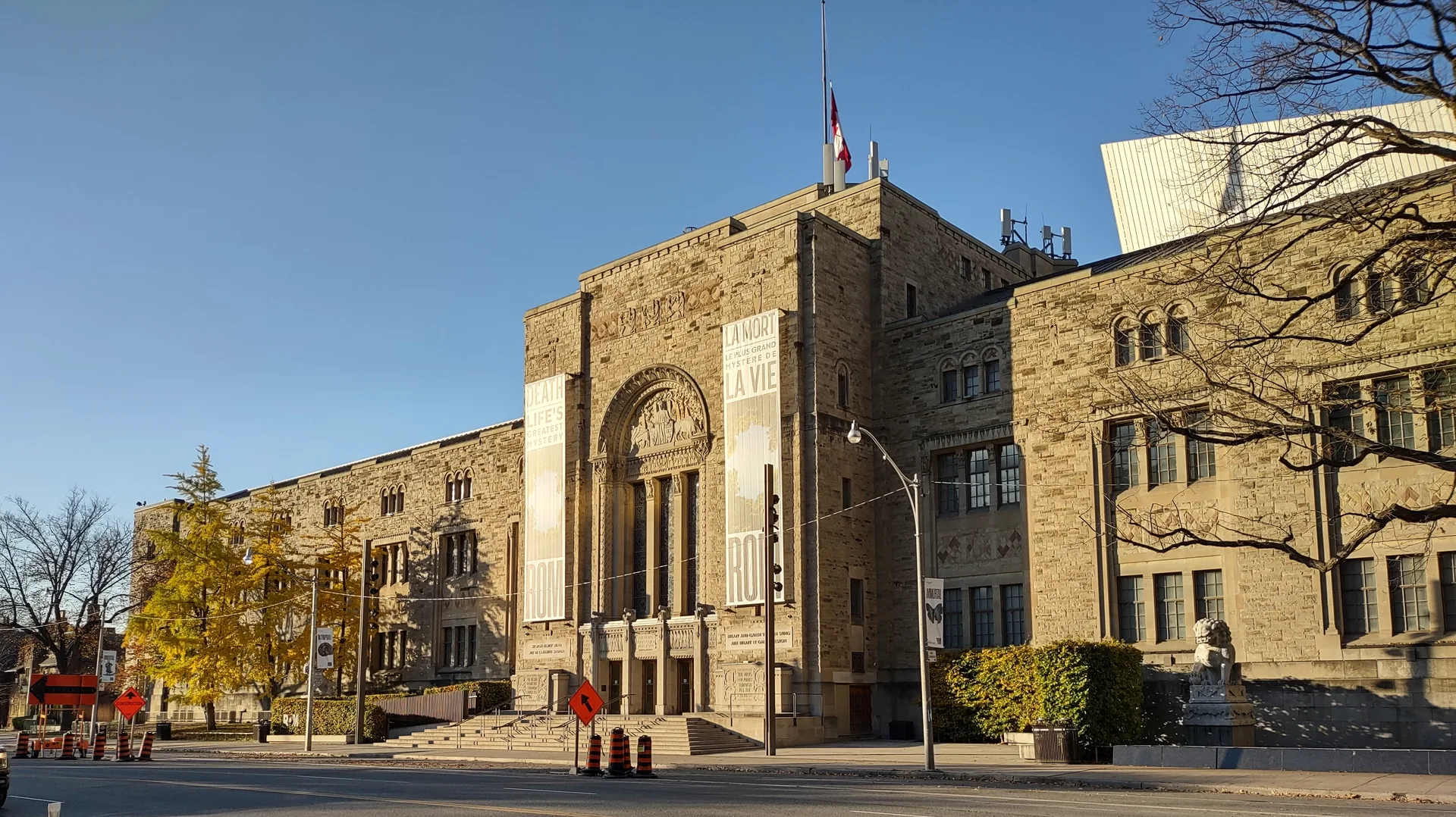
Royal Alexandra Theatre at 260 King Street West and TIFF Lightbox at 350 King Street West put stage productions and year-round cinema on the same corridor. This is a strong location for people who want performances within walking distance of dinner.
Orchestral music, opera and ballet
The Toronto Symphony Orchestra performs at Roy Thomson Hall and George Weston Recital Hall. The Canadian Opera Company’s current mainstage programme is at the Four Seasons Centre; the National Ballet also offers a full season and public dance classes.
Massey Hall: touring artists and live shows
Its programme spans concerts and other live performances. It gives downtown residents another major venue beyond the larger sports-arena shows.
Choosing a performance
TIFF’s year-round programming is distinct from September festival tickets. Performance venues and dates are programme-specific; the National Ballet also lists touring appearances outside Toronto.
Sources for this section
- Mirvish — Royal Alexandra Theatre
- TIFF — films, events and year-round Lightbox programming
- TIFF — Lightbox location and visiting
- Toronto Symphony Orchestra — 2026/27 concerts and venues
- Canadian Opera Company — current mainstage programme
- National Ballet of Canada — 2026/27 season and classes
- Massey Hall — current performances
Big-league sport and places to play
Play locally
The City’s recreation search and drop-in maps cover basketball, badminton, pickleball, skating and other activities. Programmes are organised by facility, age and session, so the community centre near a home matters more than the citywide total.
Swimming without a membership
City leisure swim sessions are free at indoor and outdoor pools. Outdoor lane swimming is also free; indoor lane swimming generally has a fee, with some free-centre exceptions.
| Watch | Venue | Area |
|---|---|---|
| Maple Leafs hockey and Raptors basketball | Scotiabank Arena | Bay Street beside Union Station |
| Blue Jays baseball | Rogers Centre | Downtown west |
| Toronto FC soccer and Argonauts Canadian football | BMO Field | Exhibition Place |
Recreation access
Outdoor pools are seasonal. Drop-in recreation is a scheduled session, not unrestricted access to a facility throughout its opening hours. Team tickets and municipal recreation are separate purchases.
Waterfront weekends and winter outings
Music Garden and Harbourfront
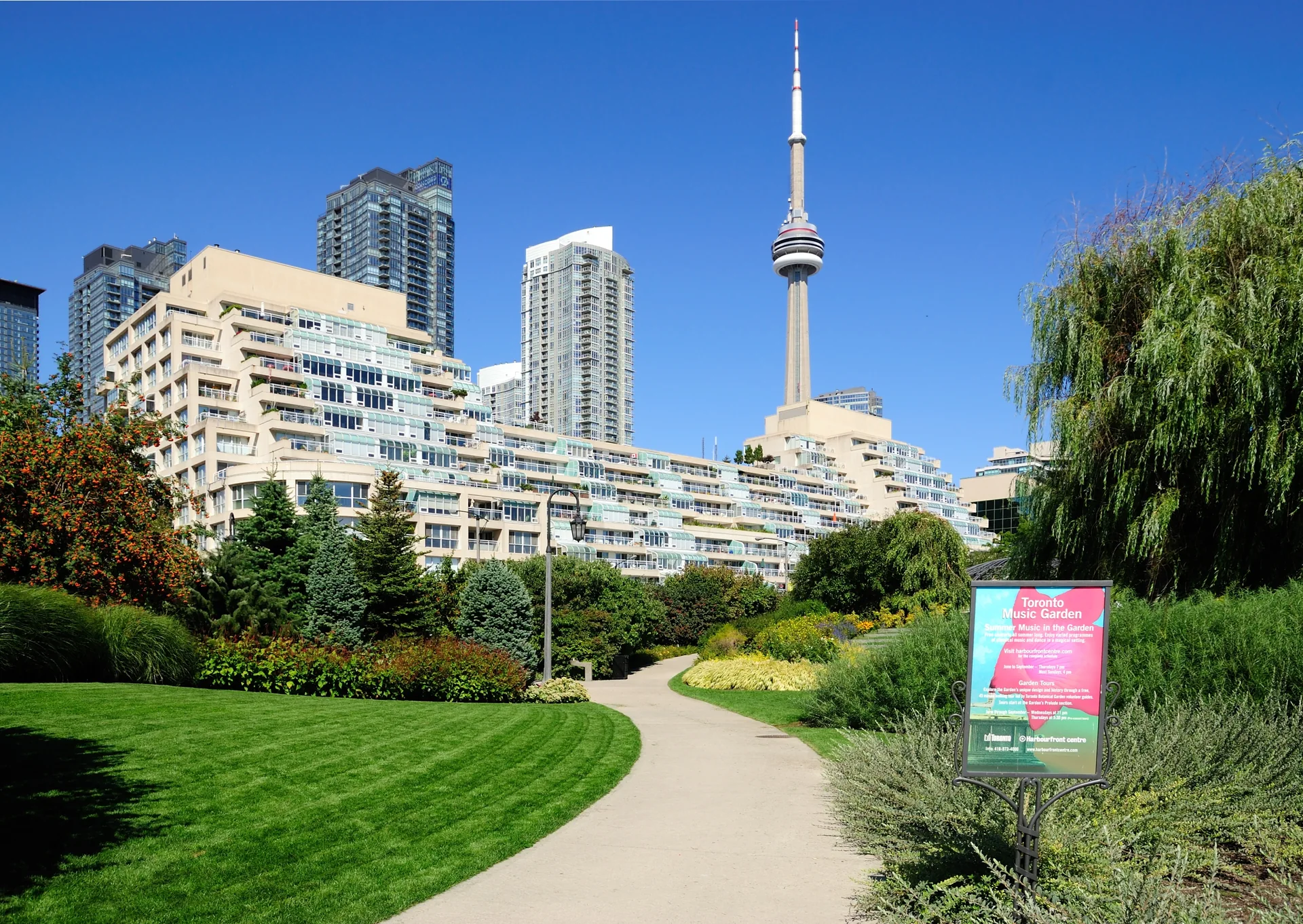
Summer Music in the Garden brings free outdoor performances to the waterfront. The 2026 season scheduled 20 concerts, with styles including classical, choral, Cuban and Persian music. Harbourfront Centre also runs craft workshops, camps and performances.
Toronto Islands
The public ferry opens up an Island Park outing without driving out of the city. It is a different weekend option from the dense downtown museum and theatre cluster.
Nathan Phillips Square in winter
The square becomes a skating destination with on-site skate rentals in season. It adds an outdoor winter activity near City Hall, while indoor pools and museums remain alternatives for poor-weather days.
Seasonal access and current notices
Outdoor concerts can be cancelled for weather or air quality. Harbourfront Centre’s main building at 235 Queens Quay West lists a temporary closure for 5–18 October 2026; consult its visitor notice for a visit during those dates. The Music Garden photo below was taken in 2008, so its sign is not a current event timetable.
What residents say
Corktown’s quiet versus Seaton Village’s everyday amenities
FitBefore50, describing life in Corktown, valued a quieter home base within reach of several nearby districts but missed some local amenities. In the same discussion, zjohnsy singled out Koreatown/Seaton Village for its parks, subway and walkable residential streets.
Read the account & context
r/askTO — favourite Toronto neighbourhoodsDifferent priorities in two central neighbourhoods; personal accounts.
Childcare offers do not necessarily match shift work
GeologistTop8894, a North York parent with shift-working parents and no nearby family after moving from abroad, described difficulty arranging childcare despite multiple waiting lists. T-Beach reported a different experience: an offer from a centre before the preferred start date, followed by another offer later.
Read the account & context
r/torontomoms — childcare waiting-list experiencesTwo parents’ accounts show why provider, timing and work schedules matter; no city-wide waiting period is inferred.
Winter darkness can be harder than the cold
Gus-Heringer described five years in Toronto after moving from Brazil and found winter darkness harder to adapt to than cold, while enjoying snow and quiet winter routines. Another Brazilian contributor, Oh-well100, reported still disliking every winter after more than twenty years.
Read the account & context
r/askTO — adapting to Toronto wintersContrasting seasonal experiences from self-described residents; health suggestions in the thread are not repeated.
The Annex: a neighbourhood worth staying in, at a price
NewsreelWatcher recalled enjoying the Annex as a student, with nights out and walks home through its residential streets, but later being unable to afford to remain.
Read the account & context
r/askTO — favourite Toronto neighbourhoodsSelf-described former student resident; a retrospective affordability experience.