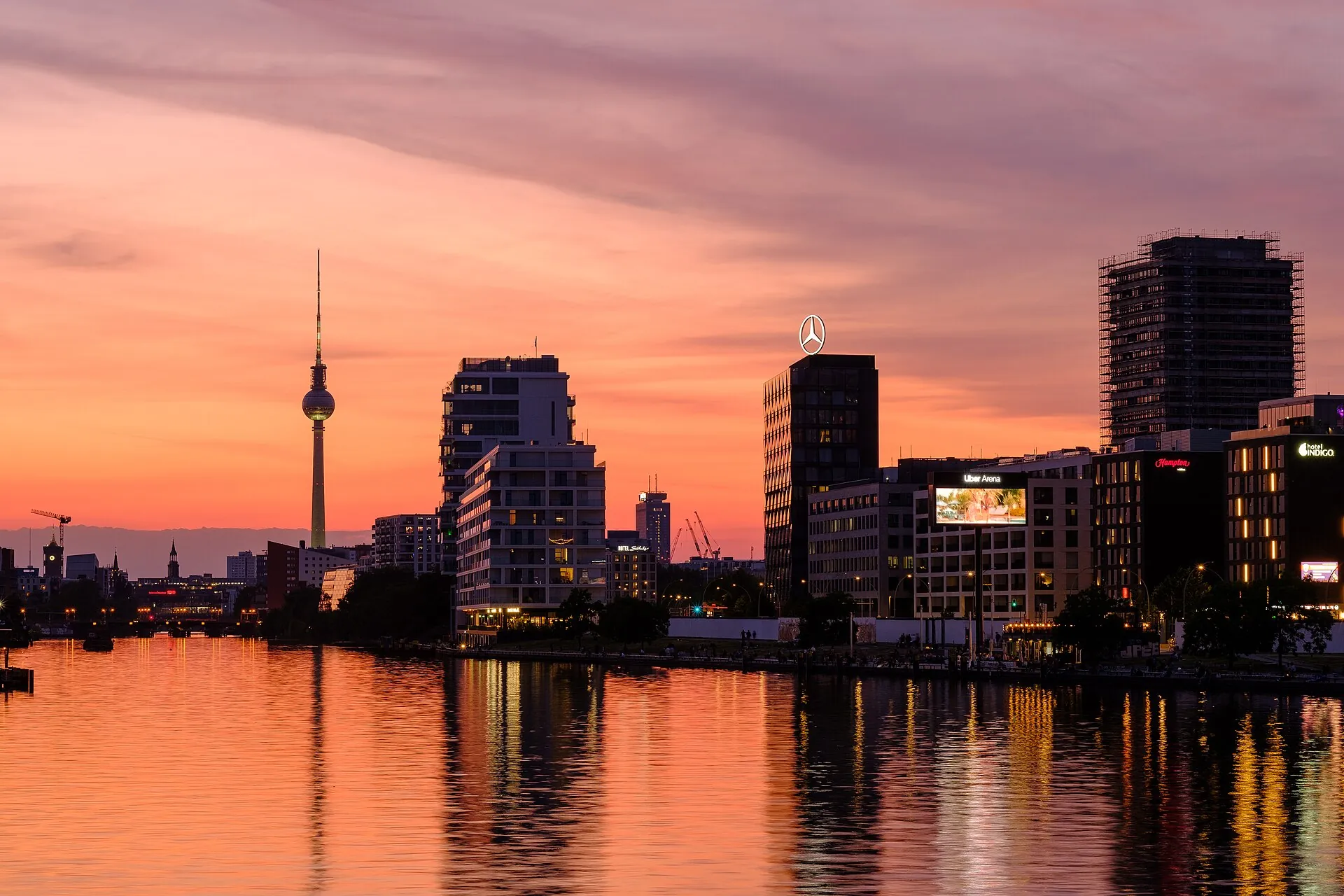
City at a glance
Berlin is a collection of neighbourhoods, with different daily lives
Berlin can offer a substantial professional and cultural life without organising every day around a car. The practical question is which combination of home, school, workplace and local community makes that possible for your household. A central address can still create an awkward cross-city school run; a quieter outer area can work well when it is on the right railway line.
This guide covers the city-state of Berlin. It distinguishes Berlin from the much larger Berlin–Brandenburg capital region, which includes the whole surrounding state, rural areas as well as suburbs. Airport access, an employer described as “Berlin-based”, or an international school address may take you across that boundary.
German is the working language of much of the housing and public-administration process. English-language information is available through the Welcome Centre and many institutions, ask each provider about the language available for your appointment or consultation.
| Geography | Population at 31 December 2025 | What the figure covers |
|---|---|---|
| Berlin city-state | 3,700,577 | Official census-based population update; city and state share the same boundary. |
| Brandenburg state | 2,551,889 | The complete surrounding state, including places well beyond a daily Berlin commute. |
| Berlin–Brandenburg capital region | 6,252,466 | Our sum of the two official state totals. A broad administrative/metropolitan region, not the continuous urban area. |
What may appeal
- A choice of distinct neighbourhoods, from busy café streets to quieter residential settings.
- Public and bilingual education options, alongside private international schools with separately published admissions and fees.
- Substantial cultural and research institutions, with some free or modest-cost activities for a regular weekly routine.
- Local and regional public-transport connections can support a car-free household when the home and daily destinations fit.
What to weigh up
- Advertised rents and competition for homes make a historic tenancy price a poor arrival budget.
- School, childcare, insurance and address registration involve separate decisions; securing one does not resolve the others.
- A cross-city commute or suburban school can erode the convenience of a seemingly central home.
- Housing quality, summer heat, noise and winter costs require building-level checks; neighbourhood reputation is not enough.
Cost of living
Build the budget around the home you can actually rent
The most useful distinction is between advertised rent and the rent used in a legal comparison. IBB’s 2025 median for advertised apartments was EUR 15.78 per square metre net cold. The 2026 Mietspiegel reports EUR 7.71 for its relevant surveyed tenancies. The rental index measures a different population and should be used for its legal comparison purpose; advertised homes provide the starting point for an arrival budget.
IBB’s listing median was EUR 19.22/m² inside its inner-city boundary and EUR 13.01 outside. These are broad geographic medians across apartment sizes and types. They are not a quote for a furnished apartment or a particular 70 m² home. For scale only, multiplying the citywide median by 70 gives EUR 1,104.60 basic rent per month; the same arithmetic gives EUR 1,345.40 at the inner-city median and EUR 910.70 at the outer-city median.
For an illustrative two-adult household, EUR 1,104.60 basic rent, two EUR 63 travel subscriptions and one EUR 18.36 household broadcasting contribution total EUR 1,248.96 per month. This is a subtotal, not a cost-of-living estimate. Add the property’s operating and heating advances, electricity, internet, food, health cover, childcare or school, and any car costs. A listing described as warm rent still needs an item-by-item check.
Keep the initial cash requirement separate. A deposit is tied-up money, not recurring consumption; furniture, an unequipped kitchen, relocation transport and overlapping accommodation can materially increase arrival costs. At an illustrative EUR 1,104.60 basic rent, a three-month deposit would be EUR 3,313.80. Budget those setup costs separately from the deposit instalments.
| Budget line | Dated benchmark or basis | What still needs pricing |
|---|---|---|
| Basic rent | 2025 advertised median EUR 15.78/m²/month | Exact size, location, furnishing, condition and lease; utilities excluded. |
| Heating and building charges | Use the lease and latest operating-cost statement | Which costs are advances with later reconciliation; heating system and consumption. |
| Electricity, internet and mobile | Obtain address-specific offers | Contract term, connection date, usage and whether anything is already included. |
| Local/regional travel | EUR 63 per adult/month, 2026 subscription | Long-distance trains, taxis, parking and any excluded supplements. |
| Broadcasting contribution | EUR 18.36 per dwelling/month, current published rate | One household payment, subject to applicable exemptions or reductions. |
| Food and ordinary purchases | Use your own grocery basket and current shop prices | No representative Berlin household food total is assumed here. |
| Health cover | Depends on eligibility, employment and insurance history | Employer deductions, premiums, dependants and uncovered treatment. |
| Childcare / private school | Kita care generally fee-free with EUR 23 monthly meals; private tuition separate | Eligibility, hours, extras, school admissions and each provider’s current schedule. |
Sources for this section
- IBB — Berlin housing-market report 2025
- Berlin Senate — Publication of the 2026 qualified rent index
- BVG — Deutschlandticket questions
- ARD ZDF Deutschlandradio Beitragsservice — Household broadcasting contribution
- German Civil Code — Section 551: Residential security deposits
- Berlin Welcome Centre — Finding and starting kindergarten
- BBIS — School fees 2026/27
Neighbourhoods & finding a home
Websites to find a home
| Website | Search for | Coverage |
|---|---|---|
| ImmoScout24 — Berlin rentals | Rent | Berlin city; apartments |
| ImmoScout24 — Berlin apartments for sale | Buy | Berlin city; apartments |
| Immowelt — Berlin rentals | Rent | Berlin city; apartments |
| Immowelt — Berlin apartments for sale | Buy | Berlin city; apartments |
About these links
Property-search websites help you find listings; individual properties and agents have not been vetted by Offshore Capitalist. Confirm availability, the legal right to let or sell, and payment instructions before committing.
- ImmoScout24 — Berlin rentals · Checked 2026-10-14
Filter by district, size, furnishing, long-term availability and total costs. Some listings require WBS eligibility or are furnished/temporary; verify the provider and contract.
- ImmoScout24 — Berlin apartments for sale · Checked 2026-10-14
Filter by district, size, occupancy and condition. Asking prices are not achieved sale prices; verify vacant possession, acquisition costs and owners’ association obligations.
- Immowelt — Berlin rentals · Checked 2026-10-14
Filter by district, size, furnishing, long-term availability and total costs. Some listings require WBS eligibility or are furnished/temporary; verify the provider and contract.
- Immowelt — Berlin apartments for sale · Checked 2026-10-14
Filter by district, size, occupancy and condition. Asking prices are not achieved sale prices; verify vacant possession, acquisition costs and owners’ association obligations.
Compare neighbourhoods before competing for an apartment
The areas below are starting points for a scouting visit. They are not rankings of school quality or safety. Compare the actual street and building: a courtyard bedroom and a road-facing bedroom can produce different experiences at the same address. Visit at the school-run hour and in the evening, and walk to the station you would use.
Use the rental and purchase portals linked with this guide, and also search the state-owned housing companies through InBerlinWohnen. Berlin’s Welcome Centre recommends a prepared application and quick responses to viewings. Ask which identity, income and financial documents the landlord needs; self-employed and newly arrived applicants should ask what equivalent evidence is accepted. For social-housing listings, check whether a Wohnberechtigungsschein is required and whether you qualify.
Before committing, obtain the Kaltmiete, operating-cost and heating breakdown, furnishing inventory, permitted occupants, adjustment clauses and move-in date. Check whether a quoted kitchen belongs to the apartment or must be acquired separately. Confirm the provider can issue the actual move-in confirmation needed for address registration. Verify the property and the person entitled to let it before transferring money.
The normal residential-deposit ceiling is three months of basic rent, with payment in three equal instalments available under section 551 BGB. For a rent challenge, use the property-specific 2026 Mietspiegel and Berlin’s Mietpreisprüfstelle: construction date, applicable exemptions, previous rent and the contractual facts matter. A citywide median cannot determine whether a particular contract is unlawful.
If buying, Berlin’s property-transfer tax is 6% of the relevant consideration, before separate notarial, register, financing or any brokerage costs. Ask an independent adviser to examine ownership, tenancy, the owners’ association documents, reserves and planned building works. An attractive asking price does not establish the future maintenance burden or the ability to obtain vacant possession.
| Area to investigate | Local character and housing | Who may find it convenient | What to test |
|---|---|---|---|
| Prenzlauer Berg: Kollwitzplatz / Helmholtzplatz | Established residential streets, older apartment buildings, cafés and playgrounds. | Households wanting a busy local walking routine. | Actual school catchment, stairs/lift, street noise and the route beyond the local neighbourhood. |
| Kreuzberg: Bergmannkiez / Graefekiez | Lively streets around shops, cafés and public spaces; canal and park access varies by address. | People who want local food, culture and an active urban setting. | Evening noise, bedroom orientation, bicycle storage and school-run traffic. |
| Charlottenburg: Savignyplatz / Karl-August-Platz | A western-city base with established shopping and apartment neighbourhoods. | Households whose work, school and social life are in the west. | Connections to eastern workplaces or a Brandenburg school, rather than assuming one “central” commute. |
| Weißensee: lake / Komponistenviertel | Residential streets and access to the lake and local green space. | People seeking a quieter home while retaining urban services. | Tram dependence, changes and service disruption on your specific journey. |
| Adlershof and nearby southeast | A science and technology campus with research, offices and residential development. | Households with a genuine southeast work or study connection. | Walk from home to the precise campus building; compare the trip to friends, schools and central cultural venues. |
Sources for this section
- Berlin city portal — Prenzlauer Berg
- Berlin city portal — Kreuzberg
- Berlin city portal — Charlottenburg
- Berlin city portal — Weißensee
- WISTA — Adlershof science and technology park
- Berlin Welcome Centre — Finding accommodation
- German Civil Code — Section 551: Residential security deposits
- Berlin Senate — Mietpreisprüfstelle: Rental-price review service
- Berlin Senate — Publication of the 2026 qualified rent index
- Berlin Finance Senate — Property transfer tax
Work, business & opportunities
Match your work to Berlin’s actual employment centres
Berlin’s employment options extend well beyond startups. The city’s economic-development portal lists healthcare, transport, industrial, public-service and digital employers. Its June 2026 employer compilation includes surrounding districts as well as Berlin; do not treat a regional employer list as proof that every job sits within the city boundary.
For research and technology, Adlershof is a concrete place to investigate. Its operator lists photonics and optics, IT and media, biotechnology and environmental technology, research institutes, startup support and specialist workspace. A business that needs laboratories has a different location brief from a consultant who needs a quiet room and reliable video calls.
Use the Federal Employment Agency’s Berlin search and the employer’s own vacancy pages to test demand for your profession. Check the search radius, worksite, language requirement and recognition of qualifications. Clinical, administrative and regulated roles may require specific language skills or recognition of qualifications.
For your own business, separate the workspace decision from permission to work, German tax residence, payroll and company management. Before signing an office or coworking commitment, check permitted use, meeting facilities, internet at that building and whether clients’ working hours suit your routine. The Germany guides hold the national requirements.
| Field | Examples and places to investigate | Decision for a relocating household |
|---|---|---|
| Healthcare and research | Charité, Vivantes and the Adlershof science campus | Confirm the exact campus or hospital, professional recognition and working hours. |
| Transport and infrastructure | Deutsche Bahn and BVG | A corporate address is not necessarily the worksite; ask about shifts and operational locations. |
| Digital businesses | Examples in the regional employer compilation include Zalando and other digital firms | Check present vacancies, contract location and hybrid-work expectations. |
| Industrial and technical work | Siemens, Siemens Energy and Bayer appear in the employer compilation | Verify location and role directly rather than using regional headcounts as a recruitment forecast. |
| Independent research or business | Adlershof technology centres, startup facilities and workspace | Confirm the premises fit the business before assuming a general office membership will do. |
Schools & childcare
Secure an education plan before fixing the school run
Berlin public-school entry normally starts for children who turn six by 30 September. The Welcome Centre explains how the local school authority handles registration and placement, including children arriving from abroad. Bring previous school reports and ask how language needs and school-entry health assessment will be handled. Starting with the competent Schulamt is more useful than assuming a preferred school has a place.
For bilingual education, the public Staatliche Europaschule Berlin offers nine language combinations and starts bilingual teaching in grade one. It is tuition-free, but its programme and entry requirements differ from simply requesting an English-speaking classroom at a neighbourhood school. Check the chosen school’s language assessment, year group and available place.
BBIS is a separate private option in Kleinmachnow, Brandenburg, outside Berlin. Its 2026/27 published annual tuition is up to EUR 19,400 for grade one under its income-adjustment structure, and EUR 25,000 for grade eleven. Initial registration can be up to EUR 7,500. Confirm eligibility for any reduction and add transport, lunches, trips and applicable exam charges. Housing in eastern Berlin may create a demanding journey to this western suburban campus.
For additional learning or inclusion needs, contact the SIBUZ serving the school’s district. Its advice is free and confidential. Ask both the school and the advice team what support the proposed class can provide, and agree the transition arrangements.
| Need | Local route | Timing, cost and availability |
|---|---|---|
| Public primary school | Schulamt / assigned school; assess language and school-entry requirements | Confirm the current annual registration window and the process for an arrival during the school year. |
| Bilingual public education | Staatliche Europaschule Berlin | No tuition; programme-specific language and admission requirements remain. |
| Private international education | Apply directly to the chosen school; compare curriculum and campus | Get a written place offer and the full fee schedule before committing to the associated commute. |
| Kita | Jugendamt voucher plus a separate search and provider contract | Apply up to nine months before the desired start and preferably at least two months ahead. A voucher does not reserve a place. |
| Kita funding and hours | Berlin care is generally fee-free; meal contribution EUR 23/month | Confirm entitlement, approved hours and optional extras; longer hours are assessed separately. |
| Primary-school aftercare (eFöB) | Apply through the responsible Jugendamt | Apply at least three months before desired start. Grades 1–3 care is fee-free; grades 4–6 may require income-based contributions. Public primary-school lunch is free in grades 1–6. |
Sources for this section
- Berlin Welcome Centre — School registration and language support
- Berlin Senate — State European School bilingual programmes
- Berlin Senate — State European School
- BBIS — School fees 2026/27
- Berlin Senate — School psychology and inclusion advice
- Berlin Welcome Centre — Finding and starting kindergarten
- Berlin Senate — Kita and welcome vouchers
- Berlin Welcome Centre — Primary-school aftercare
- Service Berlin — Apply for supplementary school care
Healthcare
Find the right local practice as well as the right insurance
Health-insurance eligibility is a German national question; local medical access is a separate task. Establish whether you will use statutory insurance, private insurance or another valid arrangement before assuming a premium or a family entitlement. When contacting a practice, identify that arrangement and ask whether it accepts new patients under it.
For routine care, search for an appropriate practice near home or work, including the language you can use for a clinical discussion. Bring medication details, prior reports, vaccinations and relevant specialist records. Arrange continuity for an existing condition before your medicine or current referral runs out, and confirm the first appointment directly.
Charité has several campuses. Mitte, Virchow-Klinikum and Benjamin Franklin are different destinations, so follow the department and appointment letter rather than merely searching for “Charité”. For dentistry, KZV Berlin’s directory includes language and accessibility information supplied by practices; confirm those details when booking.
| Situation | Where to start | Important distinction |
|---|---|---|
| Routine GP or specialist appointment | 116117 practice search and the practice itself | Check language, new-patient availability, insurance acceptance and whether a referral is needed. |
| Dental care | KZV Berlin dentist directory | Discuss coverage and the treatment estimate; a listed language or facility should be confirmed directly. |
| Urgent medical problem that is not life-threatening | 116117 for medical guidance and out-of-hours care | The published telephone service is in German. English-language information and doctor search are available online. |
| Life-threatening emergency | 112 | Do not wait for a routine booking or travel to a distant preferred practice. |
Getting around
Price the journey and test the whole route
Berlin’s practical transport advantage is choice between rail, tram, bus, cycling and walking. It is strongest when the home and regular destination fit together. Use the live route planner with the arrival time you actually need, include the walk and transfers, and repeat the check when construction or replacement services are announced.
The Deutschlandticket costs EUR 63 per month in 2026 and is a subscription covering local and regional public transport. Ordinary long-distance ICE and IC travel is not generally included. For a short scouting visit or occasional journeys, compare individual and 24-hour VBB tickets instead of assuming a subscription is necessary.
When evaluating a car-free household, include groceries, school pickup, disability access and the late return journey. Walk the station access and check lifts rather than assuming a station symbol means a step-free route. For cycling, inspect the actual junctions and storage; the straight-line distance is not a useful substitute for a comfortable route.
For a car, the environmental zone within the inner S-Bahn ring normally requires the green emissions sticker, with specific exemptions. This can also matter to a foreign-registered vehicle. Check the official zone and parking arrangements at the exact home; neither a tenancy nor a resident permit should be assumed to provide a dedicated parking space.
| Adult ticket | Published 2026 price | Use and limit |
|---|---|---|
| Single Berlin AB | EUR 4.00 | A city journey within the ticket conditions; BER requires the appropriate additional zone. |
| Single Berlin ABC | EUR 5.00 | Includes the airport’s zone for a journey within the ticket conditions. |
| 24-hour Berlin AB | EUR 11.20 | Useful for several city journeys during the validity period. |
| 24-hour Berlin ABC | EUR 12.90 | Compare with singles for a day including BER and other journeys. |
| Deutschlandticket | EUR 63/month | Personal subscription; local/regional coverage, cancellation terms and long-distance exclusions apply. |
Airports & international connections
BER connections depend on the home as well as the timetable
Berlin Brandenburg Airport (BER) is the principal airport serving the city and is located in Brandenburg. Use the linked airport record for the operator and international-service classification. For destinations you visit often, check the airport or airline’s current timetable: seasonality and a one-stop connection can matter more than a general airport size ranking.
The airport railway station is beneath Terminal 1 at level U2; Terminal 2 is reached through Terminal 1. The airport currently publishes approximate fast-train journeys of 23 minutes from Hauptbahnhof, 19 from Potsdamer Platz and 14 from Südkreuz. These timings cover the railway journey.
The airport’s notice says FEX and RE20 together provide four trains an hour until December 2026. Check the travel-notice page on the day, particularly for early flights and replacement transport. Add the trip to the city station, waiting, the terminal walk and the airline’s check-in allowance.
For conventional VBB tickets, a trip from central Berlin to BER needs ABC coverage. A qualifying local/regional journey can fall within a Deutschlandticket, but the train category and any disruption arrangements still need checking. The household comparison is how often you fly, when you return, and how reliable the full trip feels from each shortlisted home.
Gateway options
Compare gatewaysBerlin Brandenburg AirportBER
InternationalSchönefeld, Brandenburg; serves Berlin ·  Germany
Primary gateway Berlin Brandenburg Airport (BER) is in fare zone C. For a conventional ticket from the airport to central Berlin, the airport specifies ABC coverage. The station is under Terminal 1; Terminal 2 requires the signposted onward walk. Check the actual ticket product and whether a paper ticket needs validation before boarding.
International gateway for Berlin. Compare the current destinations, operating season and ground transfer for your itinerary.
Sources & connectivity notes
International passenger services. Check current routes and seasonal schedules.
Research checked 2026-10-13. Routes can vary by season.
Climate & environment
Month by month
Berlin-Tempelhof · 47.72 m (1991–2020 site) · 1991–2020 averages
Temperature calculations from DWD data; rainfall © DWD · CC BY 4.0
January averages
- Mean daily high
- Mean daily low
- Monthly precipitation
°F and inches are converted from the metric values and rounded for display.
July average daily highs/lows are 25.2°C / 15.1°C, compared with 3.6°C / −1.4°C in January. Rainfall occurs in every month. These averages help compare seasons; heatwaves, freezing spells and intense rain are not shown by a monthly mean.
Tempelhof is an open urban weather station, not a measure of every Berlin street. Enclosed courtyards, upper-floor apartments and tree cover can change heat exposure. The chart combines calculated temperature averages with DWD’s published rainfall averages for the same 1991–2020 period.
All monthly values
| Month | Mean daily high | Mean daily low | Monthly precipitation |
|---|---|---|---|
| January | 3.6°C | -1.4°C | 47.7 mm |
| February | 5.1°C | -0.8°C | 36.0 mm |
| March | 9.0°C | 1.4°C | 40.5 mm |
| April | 15.1°C | 5.2°C | 29.3 mm |
| May | 19.6°C | 9.3°C | 52.3 mm |
| June | 23.1°C | 12.8°C | 58.2 mm |
| July | 25.2°C | 15.1°C | 71.7 mm |
| August | 24.9°C | 14.7°C | 58.1 mm |
| September | 19.9°C | 10.9°C | 46.6 mm |
| October | 14.0°C | 6.6°C | 43.9 mm |
| November | 8.0°C | 2.7°C | 41.7 mm |
| December | 4.4°C | -0.1°C | 44.2 mm |
Sources, station & data quality
Deutscher Wetterdienst (DWD) station 00433 · Berlin-Tempelhof · 47.72 m (1991–2020 site). These averages describe the stated period; they are not a forecast. Temperatures are average daily highs and lows, not extremes. Precipitation is an average monthly total, not a count of wet days.
We calculated each high and low as the arithmetic mean of 30 DWD monthly MO_TX and MO_TN observations from 1991 through 2020, rounded to 0.1°C. These are our calculations from official data, not a separately published DWD high/low-normal table.
The historical monthly records retain quality codes 9 and 10. DWD defines 9 as not all parameters corrected and 10 as quality control and corrections finished. These calculations do not add homogenisation or fill missing temperature values.
Two precipitation months are absent from the raw monthly file (May and June 2019). They are never treated as zero or −999 in an average. The rainfall chart instead reproduces DWD’s independently published station means, method 45.
The station geography metadata places the 1991–2020 observations at 52.4675°N, 13.4021°E and 47.72 m. The later 2022 site update is not substituted for the reference-period location.
Celsius and millimetres are the source units. Fahrenheit = Celsius × 1.8 + 32; inches = millimetres ÷ 25.4. Conversion is rounded only for display.
Temperature averages use all 30 available monthly values for each calendar month. Rainfall uses the separately published DWD station normal: method 45 requires at least 25 available years and does not state the exact count for each value.
Choose a home that works through winter and summer
Use the monthly temperature and precipitation chart with its stated station and reference period. A long-term station average is useful for comparing seasons, but it does not predict the temperature in a roof apartment or in a particular courtyard. Berlin’s Environmental Atlas provides local layers for heat, green space, noise and air pollution; check the date and meaning of each layer.
For summer, inspect shading, bedroom orientation and whether ventilation is possible without intolerable street noise. Berlin’s health authority recommends shading rooms during the day and ventilating when outdoor air is cooler. The practical housing question is whether the building allows that, especially for upper-floor bedrooms or a home office.
For winter, ask for the heating arrangement, controls and the previous building-cost statement, then test draughts, glazing and damp rather than judging comfort from a summer viewing. For the darker, colder part of the year, rehearse the school run and a public-transport alternative to the bicycle.
For environmental exposure, compare the actual address on the official maps and visit with windows open and closed. Traffic noise, street-facing bedrooms and access to green space may influence daily life more than a citywide annual average. A map category alone cannot certify indoor air quality or rule out property-specific water or moisture problems.
Sources for this section
Safety & everyday risks
Use local evidence without turning it into a neighbourhood ranking
Berlin recorded 502,743 offences in its 2025 police crime statistics, 6.7% fewer than the previous year; the Senate published the results in March 2026. These are recorded cases across the city. They include circumstances involving visitors and commuters as well as residents, and should not be divided by the resident population to suggest your personal likelihood of becoming a victim.
The police crime atlas lets you examine local categories and reporting periods. Compare similar areas and offences, then test your actual daily routes. A transport interchange or nightlife destination draws a different population from a residential street, while unreported incidents do not appear as recorded cases.
On a scouting visit, look at the route home after dark, entrance security, bicycle storage and the school-crossing environment. In a rental search, independently verify the property, landlord authority and payment terms; pressure to transfer money before verification deserves scrutiny. Do not use a positive online anecdote as a substitute for those checks.
For an immediate police emergency, call 110. Non-urgent matters can use the police Internetwache or service contact. Berlin’s LADS directory provides routes to discrimination advice; select the service appropriate to the incident and institution involved. For urgent medical emergencies, use the medical pathway above.
Public services & practical setup
Set up the address, contracts and local services in the right order
Address registration is normally due within 14 days of moving in. Service Berlin distinguishes temporary-stay exceptions, including certain people already registered elsewhere in Germany staying up to six months and visitors normally resident abroad staying up to three months. Check the applicable exception rather than assuming every short let is exempt. The residence registration process is separate from immigration permission.
Take the identity documents and actual accommodation-provider confirmation required for your case. Check the eligibility and electronic-identification conditions before choosing online registration. Keep the registration confirmation with the documents used for school, banking and other applications.
Arrange electricity and internet around the handover date. The electricity market’s 24-hour technical switching process does not remove contract notice periods. Record meter numbers and readings, clarify who pays water and heating, put the correct names on the letterbox and keep the first bills so that missing or duplicated contracts are visible.
| Task | Local action | What to retain or confirm |
|---|---|---|
| Building services | Ask the landlord or manager for heating, water and operating-charge arrangements | Which payments are advances, what is separately contracted, and the annual reconciliation process. |
| Waste and bulky items | Use BSR’s sorting guide and official disposal services | Building bins and access; organise furniture disposal instead of leaving items on the pavement. |
| Broadcasting contribution | Register the dwelling or identify an existing household payer | One dwelling payment; keep the reference and check any exemption separately. |
| Library access | Use the district public library and its current registration rules | Regular adult annual fee published as EUR 10; concessions and particular services have their own conditions. |
| Language and adult learning | Search Berlin’s twelve district Volkshochschulen | Choose the course level, timetable and location; ask about eligibility for any subsidised programme. |
| Family and support services | Use the responsible Jugendamt, school authority or district advice service | Appointments and proof depend on the service; address registration alone does not enrol the household. |
Sources for this section
- Service Berlin — Register a sole or main residence
- Bundesnetzagentur — Electricity supplier changes and moving home
- ARD ZDF Deutschlandradio Beitragsservice — Household broadcasting contribution
- BSR — Waste separation in Berlin
- Berlin public libraries — Library fees
- Berlin Senate — Adult education centres
Culture, community & daily life
Build a routine beyond the city’s visitor highlights
Berlin’s cultural value is easier to judge through a week you would repeat than through a list of monuments. Try a neighbourhood market or café, a regular class, an evening performance and an outdoor activity from the homes you are considering. The journey and the community around each activity are part of the decision.
The Philharmonie’s lunchtime concerts are a tangible low-cost option: Wednesdays at 13:00 from September to June, generally around 40–50 minutes, with free admission until capacity is reached. They are mostly standing events, with limited disability seating. A free event is still a scheduled commitment rather than an unlimited drop-in facility.
Tempelhofer Feld offers space for activities such as cycling and skating, with seasonal opening times and designated-use rules. Its operator recommends public transport because parking is very limited. For a quieter regular indoor activity, compare local libraries and Volkshochschule courses rather than expecting social connections to appear automatically.
Check the current status of major museums. As researched in October 2026, the Pergamonmuseum building remains closed; part is scheduled to reopen on 4 June 2027. Pergamonmuseum. Das Panorama is a separate exhibition. A familiar attraction name in an old relocation list is not reliable evidence that it is open this week.
What residents say
Different households describe different versions of Berlin
These attributed public comments are self-selected anecdotes; identities and residence histories are unverified. They are not client testimonials. Use them to identify questions for your own visit: tram reliability, evening activity, quiet at home and the commute.
The February discussion shows how much priorities matter: one person wanted a quieter home, while another saw family life and culture as compatible. Compare their perspectives with the housing, school and transport evidence above.
These are attributed public experiences, not client testimonials. Housing, neighbourhood and household circumstances affect the experience.
paperplane030 valued Berlin’s events, sport and nightlife, but said changing priorities were leading them to seek a quieter home elsewhere. Their priorities had changed since moving to the city.
February 2026 discussion; describes plans to leave as personal priorities change.
In reply, sleni_ disputed the idea that Berlin must be a choice between partying and settled family life, while agreeing that housing is difficult. The disagreement is useful when deciding which community and neighbourhood to explore.
February 2026 reply to the same discussion, offering a contrasting view of settled life.
Low-Fondant-9725 described living in Charlottenburg and challenged a broad claim that every outer-area trip to the centre is short. The practical lesson is to time a named destination from a named address, rather than adopt a universal Berlin commute.
Self-described Charlottenburg resident in the February 2026 discussion.
Planning your move
Make the scouting visit answer the expensive questions first
Before arrival, establish the national immigration and tax position, then shortlist homes around the worksite, school or childcare option and the journeys your family will repeat. Ask schools and medical providers about actual availability. Preserve flexibility while those decisions remain unresolved: a beautiful long-term lease can be a poor choice if the needed school or treatment is across the city.
During a scouting visit, walk the candidate neighbourhood at different times, test the commute and airport journey, compare actual rental documents and inspect summer as well as winter comfort. Prepare a household budget from written property and provider information. Include one-off setup costs and allow for the time taken to secure a permanent home.
After the move, use the sequence below to coordinate registration, services and family administration. Germany’s tax, residency and banking guides address the national decisions; this city guide addresses how you put everyday life in place. If the move also involves a business or assets in another country, discuss that combined situation before choosing the implementation steps.
Sources for this section
- Service Berlin — Register a sole or main residence
- Berlin Welcome Centre — School registration and language support
- Federal Ministry of Health — Statutory health-insurance membership categories
- Berlin Brandenburg Airport — Public transport and fare zones
- German Civil Code — Section 551: Residential security deposits
Your move, step by step
These stages show dependencies rather than a guaranteed completion schedule. The school, housing and insurance tasks can run in parallel.
01Set the legal brief and school geographyBefore choosing a permanent neighborhood
Confirm the relocation and business plan, check school year placement and map recurring destinations. Start insurance eligibility checks before assuming a particular household cost.
Documents & evidence
- Passports, current status and insurance records, school reports and household budget.
02Review the home and commit to documented termsBefore paying the deposit
Reconcile the rent breakdown, contract, landlord authority and property condition. Confirm the move-in date, deposit handling and accommodation provider’s registration confirmation.
Documents & evidence
- Signed agreement, inventory, rent breakdown, deposit record and handover arrangements.
03Arrange energy and internet for handoverBefore taking over consumption
Identify the meter and establish the intended electricity supply in advance. Record readings and arrange broadband installation; check what heating and water payments the landlord handles.
- The 24-hour technical switching process does not erase contract notice periods.
04Complete address and family administrationAfter moving in; registration normally within 14 days
Use the appropriate registration route, then preserve the confirmation alongside the household’s school, childcare and insurance records.
Documents & evidence
- Identity documents, registration form, Wohnungsgeberbestätigung and applicable family documents.
- A lease alone does not replace the move-in confirmation; a Kita voucher does not reserve a place.
05Test the working week and keep a review calendarDuring the first settled weeks
Check the commute, healthcare access, bill allocation and school or childcare routine. Record lease adjustments, annual operating-cost statements, insurance and permission deadlines.
Documents & evidence
- Provider accounts, insurance confirmation, school or childcare contract and renewal calendar.
Sources & research notes59 references
Sources supporting this guide. Research draft awaiting editorial review.
- Berlin city portal — Prenzlauer Berg
- Berlin city portal — Kreuzberg
- Berlin city portal — Charlottenburg
- Berlin city portal — Weißensee
- German federal government — Housing and registration
- German Civil Code — Section 551: Residential security deposits
- Berlin Senate — Mietpreisprüfstelle: Rental-price review service
- Berlin Senate — Qualified rental index 2026
- Service Berlin — Register a sole or main residence
- Bundesnetzagentur — Electricity supplier changes and moving home
- ARD ZDF Deutschlandradio Beitragsservice — Household broadcasting contribution
- German federal government — Health insurance
- Federal Ministry of Health — Statutory health-insurance membership categories
- Federal Ministry of Health — Statutory health-insurance contributions
- Berlin Welcome Centre — School registration and language support
- Berlin British School — Campus addresses
- Berlin British School — Admissions process
- BBIS Berlin Brandenburg International School — Application process and location
- Berlin Senate — Kita and welcome vouchers
- Berlin Welcome Centre — Finding and starting kindergarten
- Berlin Brandenburg Airport — Public transport and fare zones
- Berlin Brandenburg Airport — Current public-transport travel notices
- Deutscher Wetterdienst — National climate report: Weather and climate in Germany
- How is it living in Weissensee? — r/askberliners — public experience
- Statistik Berlin-Brandenburg — Census-based population, 31 December 2025
- Statistik Berlin-Brandenburg — Population totals by state
- Berlin and Brandenburg — Definition of the capital region
- IBB — Berlin housing-market report 2025
- Berlin Senate — Publication of the 2026 qualified rent index
- Berlin Welcome Centre — Finding accommodation
- Berlin Finance Senate — Property transfer tax
- Berlin Business Location Center — Major employers and survey scope
- WISTA — Adlershof science and technology park
- Federal Employment Agency — Berlin job search
- Berlin Senate — State European School bilingual programmes
- Berlin Senate — State European School
- BBIS — School fees 2026/27
- Berlin Senate — School psychology and inclusion advice
- Berlin Welcome Centre — Primary-school aftercare
- Service Berlin — Apply for supplementary school care
- 116117 — English-language information
- KZV Berlin — Dentist search
- Charité — Campuses
- Berlin traffic information centre — VBB fares from January 2026
- BVG — Deutschlandticket questions
- Berlin Senate — Low-emission zone
- Berlin health authority — Heat protection at home
- Berlin Senate — Environmental Atlas
- Berlin Interior Senate — Police crime statistics 2025
- Berlin Police — Crime atlas
- Berlin Police — Emergency and non-urgent contact
- Berlin LADS — Anti-discrimination advice
- BSR — Waste separation in Berlin
- Berlin Senate — Adult education centres
- Berlin public libraries — Library fees
- Berliner Philharmoniker — Lunchtime concerts
- Grün Berlin — Tempelhofer Feld visitor information
- State Museums Berlin — Pergamonmuseum visit status
- r/askberliners — Is moving to Berlin a good idea in 2026?
In a January 2026 discussion, self-described Weißensee residents praised a calmer local routine and local parks, while one highlighted dependence on trams and the inconvenience of delays. Another resident farther toward Heinersdorf described transport as less convenient despite liking the quiet. These are individual impressions, useful for deciding which journeys to test rather than scoring the entire district.
January 2026 neighbourhood discussion; contributors describe living in Weißensee and toward Heinersdorf.