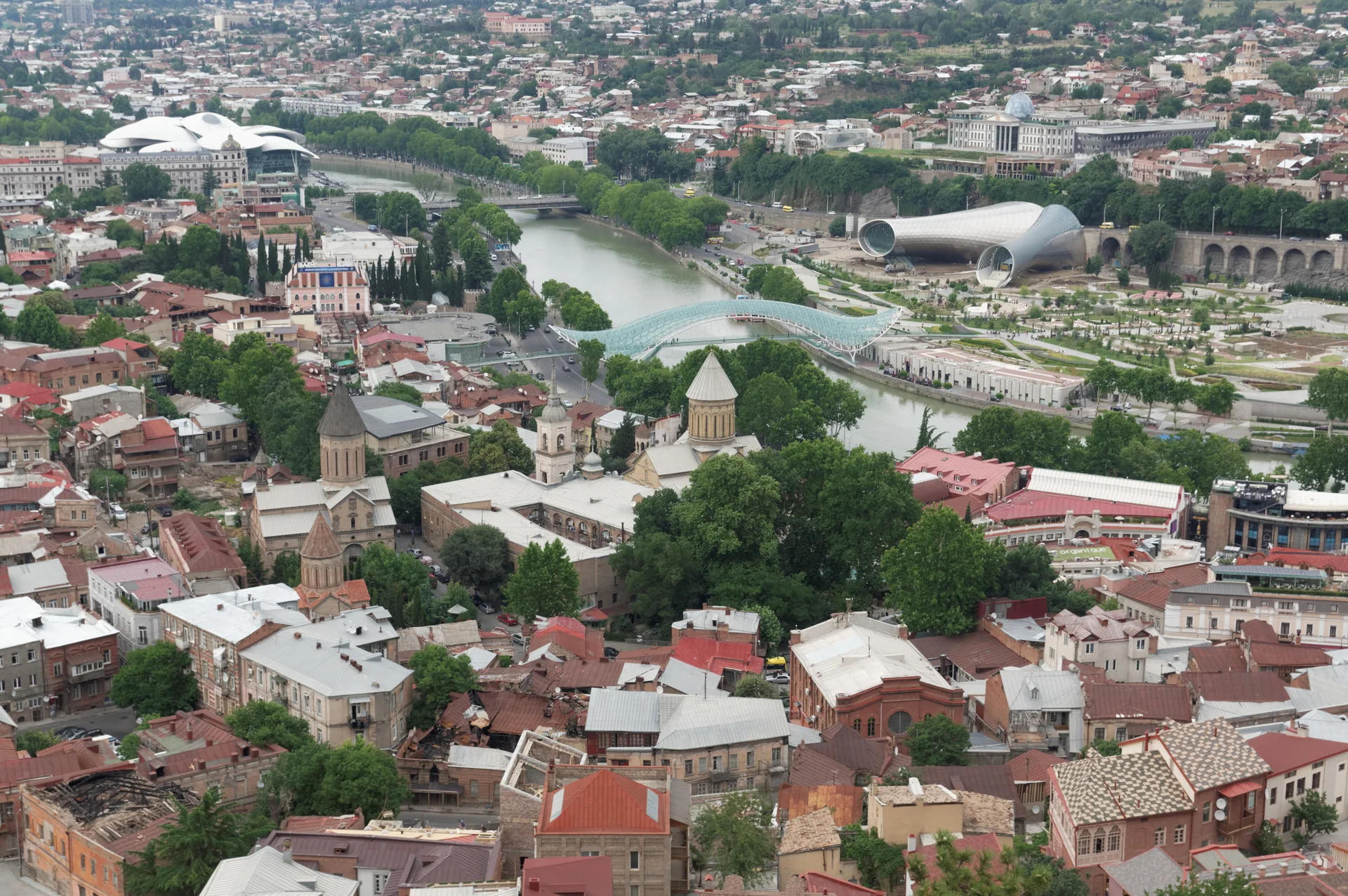
City at a glance
Choose the part of Tbilisi that works on an ordinary Tuesday
Tbilisi offers several quite different ways to live: the older streets above Freedom Square, the river’s mixed residential and visitor neighbourhoods, Vake’s parks and shopping streets, or the larger residential areas served by the metro. The useful question is not which district wins a ranking. It is whether the particular building supports the work, school, shopping and social routine you want.
Begin with three or four recurring destinations and test the journey at the times you would actually travel. The Mtkvari river, steep streets and the distance to a metro entrance can change a seemingly simple route. A central-looking pin may involve a climb or an awkward crossing, while a home farther out but near the right station may be more practical. This is an address-level comparison, not a claim that one entire neighbourhood is best.
Spend the first part of an exploratory stay testing more than one area if possible. Visit the exact street after dark and on a weekday morning, inspect the approach with luggage or a pushchair, and check the shop and pharmacy you would use. These observations are especially useful before signing for a year or choosing a school.
What may appeal
- A wide neighbourhood choice, from historic streets to metro-served residential areas.
- A metro and bus network that can make the right station more useful than a nominally central address.
- The capital offers a practical base for evaluating Georgian business, banking and household arrangements together.
What to weigh up
- Hills, crossings and the final walk can undermine a map-based commute estimate.
- Housing condition, heating and connectivity need direct inspection.
- The current work and tax rules require separate eligibility checks before relying on a low-tax relocation plan.
Neighbourhoods & finding a home
Websites to find a home
| Website | Search for | Coverage |
|---|---|---|
| MyHome.ge | Rent / Buy | Georgia — select Tbilisi or Batumi |
About these links
Property-search websites help you find listings; individual properties and agents have not been vetted by Offshore Capitalist. Confirm availability, the legal right to let or sell, and payment instructions before committing.
- MyHome.ge · Checked 2026-10-14
Choose sale or long-term rent, rather than daily rental, then the city and neighbourhood. Confirm the price currency, payment period and contract duration.
Six useful starting points for the housing search
The names used in property listings are often neighbourhood names rather than the formal administrative district. Ask for the full street address and the nearest useful transport stop. This shortlist combines tourism-authority descriptions with a clearly attributed first-hand neighbourhood account; its tradeoffs are viewing prompts, not measured rent or safety rankings.
| Area | Why consider it | Check in person |
|---|---|---|
| Sololaki / Freedom Square | Historic buildings and a central base for the old city | Inspect stairs, renovation, light, damp, courtyard access and the uphill walk to the specific building. |
| Vera / lower Mtatsminda | Older residential streets with access toward Rustaveli and central cultural destinations | Test the slope, traffic and evening noise; nearby streets can feel quite different. |
| Vake | Abashidze Street amenities and access to Vake or Mziuri parks | Central Vake is not a metro-front location; test the actual bus or road journey to work and school. |
| Saburtalo / Delisi area | A wider residential search with useful metro corridors | Choose by station and final walk, rather than treating the whole large area as equally connected. |
| Chugureti / Marjanishvili | A different central base across the river, with shops and historic streets | Separate visitor-oriented streets from the quieter residential block you would actually rent. |
| Avlabari | Old-city and river access on the other side of the centre | Check gradients, the route to the station and the condition of the specific building. |
Check the building and the agreement together
Ask for evidence that the person granting the lease owns the property or has authority to do so. NAPR provides property information and registry extracts; match the unit and owner rather than relying on a photograph of a different apartment. Put rent, currency, conversion mechanism if any, payment date, charges, term, deposit, repair responsibilities and notice terms into a written agreement you understand.
The Civil Code’s dwelling-security rule caps the security at three months’ rent and allows an advance monetary security to be paid in three equal monthly instalments. A demand described as last-month rent, an agent fee or another advance needs its own classification; do not assume every upfront payment is legally the same deposit. Record what each payment covers and obtain a receipt.
Inspect the systems that a listing photograph cannot prove: heating and hot water, ventilation, windows, electrical outlets, lift and common areas, mobile reception and an internet connection tested at the desk. Photograph defects and meter readings at handover. Agree who arranges and pays for a repair, and how the owner is contacted while abroad.
A short trial stay is also a chance to collect comparable live offers with the same furnishing, size and lease length. This guide does not invent a current average rent. Compare the total recurring budget and the initial cash requirement separately; an appealing headline rent can conceal utility, building or seasonal terms.
| Before committing | What to establish | Useful evidence |
|---|---|---|
| Legal party and unit | Match ownership/authority and the precise apartment | Registry evidence, identity and the signed agreement. |
| Money | Separate rent, security, fees, utilities and currency terms | Written breakdown and receipts for each transfer. |
| Physical condition | Test heat, hot water, ventilation, wiring and access | Dated inventory and photographs; repair procedure. |
| Working from home | Test actual connectivity and lease permissions | Connection result and any agreed permitted use. |
| Departure | Review notice, early termination and deposit settlement | The contract and the relevant Civil Code category. |
Sources for this section
One address, several different legal questions
SDA requires a residence-permit holder to register their address within one month of entry, or of receiving the permit when already in Georgia. The evidence can include ownership, owner consent or the specified alternative proof of actual residence. Discuss the accepted route with the authority and landlord before a deadline approaches; do not buy a paper address that misrepresents the household.
Tax residence and the source of income follow tax law. Payment from overseas does not alone decide whether services performed in Georgia are foreign-source, and a small-business rate depends on the actual eligible activity and status. Keep travel, contracts and receipts from the start. The country tax guide explains those issues in depth; the city choice should follow a workable overall plan.
Sources for this section
Work, business & opportunities
The 2026 work rules belong in the move plan
Georgia’s work framework changed in 2026. The current Labour Migration Act covers relevant paid work for a local employer and defined self-employed activity by foreigners without permanent residence. A residence address, individual-entrepreneur registration and tax status are separate steps; none should be treated as a universal substitute for work permission.
The current consolidated law also contains important exclusions. Article 1(4)(k) addresses work or services for a nonresident where connected with that nonresident’s activities outside Georgia. Other specified categories, including valid investment-residence permits, have exclusions. This is a facts-based statutory test—not a promise that anyone describing themselves as a remote worker is exempt. Review the actual client/employer, activity, location and permission.
For a covered person who receives the right to work, the statute generally requires a D1 application within 30 calendar days if outside Georgia, or the relevant work/IT residence application within 10 days if already inside, with exceptions for existing residence-permit holders and specified situations. The transition to 1 January 2027 is for labour immigrants with active database registration on 1 March 2026; it is not a general grace period for every newcomer.
Sources for this section
Schools & childcare
Secure school and medical arrangements before they become urgent
The Education Ministry’s 2026–27 first-grade rules use a requirement that children turn six by 15 September and a phased registration process, including an address-based stage. Older children transferring from abroad need a separate placement and records review. Ask the chosen school which documents and recognition steps apply; do not apply a first-grade calendar to every international transfer.
Bring the child’s and parent’s identity records, relevant residence evidence, prior school reports and any required Georgian translations. For a private or foreign-language programme, check the institution and programme through EQE, then verify actual language support, places, fees, transport and the qualification earned. A school’s international branding is not a substitute for checking its authorisation and the family’s needs.
For entry as a tourist, the 2026 rules require qualifying health and accident insurance, ordinarily at least GEL 30,000 covering the whole stay, with evidence in Georgian or English; defined exemptions exist. That entry policy should not be confused with comprehensive ongoing healthcare for a relocating household. Check exclusions, pre-existing conditions, outpatient care, direct billing and the procedure for reimbursement.
Before moving, identify a provider able to handle any continuing treatment, obtain prescriptions and records in a usable form, and confirm the medicines and tests needed. Language availability, charges and insurer acceptance should be confirmed with the particular provider. The guide does not promise universal free care or a particular waiting time for foreigners.
Getting around
Use the network that fits the journey
Tbilisi Transport Company publishes a standard 1 GEL fare for a ninety-minute transfer window on the covered city network. Payment medium and card conditions matter, and ropeways can have separate tariffs. Check the current official tariff rather than assuming a tourist cable-car journey and an ordinary metro/bus trip are the same product.
Tbilisi International Airport (TBS) identifies municipal route 337 outside arrivals, linking the airport with the city and Station Square. The airport page publishes a daytime-to-late-evening operating window, not an all-night service. Recheck the timetable for your flight and arrange a separate plan for an arrival outside it; do not base a late-night transfer on an old travel blog.
Test the final part of the journey as well as the transit leg. A hill, stairs or a difficult crossing can matter more than one extra stop. For a household with children, compare the school run under wet or hot conditions and establish a backup for a missed connection. Avoid committing to a precise commute time based solely on a map estimate.
Sources for this section
Airports & international connections
Gateway options
Compare gatewaysTbilisi International AirportTBS
InternationalTbilisi ·  Georgia
Primary gateway Tbilisi International Airport (TBS) identifies municipal route 337 outside arrivals, linking the airport with the city and Station Square. The airport page publishes a daytime-to-late-evening operating window, not an all-night service. Recheck the timetable for your flight and arrange a separate plan for an arrival outside it; do not base a late-night transfer on an old travel blog.
International gateway for Tbilisi. Distinguish regular scheduled services from charter options when checking destinations.
Sources & connectivity notes
International passenger services. Check current routes and seasonal schedules.
Research checked 2026-10-13. Routes can vary by season.
Kutaisi International AirportKUT
InternationalKutaisi, western Georgia · Georgia
Alternative gateway Alternative gateway. Kutaisi, western Georgia. Compare the complete onward journey to Tbilisi with your flight times, luggage and arrival hour.
International flights from western Georgia. Include the longer road transfer when comparing Kutaisi with Tbilisi or Batumi.
Sources & connectivity notes
International passenger services. Check current routes and seasonal schedules.
Research checked 2026-10-13. Routes can vary by season.
Climate & environment
Inspect for summer and winter, not only the viewing day
Georgia’s tourism authority distinguishes the more continental eastern climate from the humid Black Sea coast. For a Tbilisi home, test both summer cooling and winter heating, the direction of sunlight, window sealing and the ability to ventilate. A bright top-floor room may feel very different through a hot afternoon, while the heating arrangement matters during a winter stay.
The same approach applies to an outdoor routine. Walk the route to the park, gym, grocery shop or coworking space at a realistic time, and check whether shade or shelter changes its usefulness. These are practical selection criteria; no undated climate figure is presented here as a 2026 weather forecast.
What residents say
These are attributed public experiences, not client testimonials. Housing, neighbourhood and household circumstances affect the experience.
Planning your move
Make the city fit the international plan
Tbilisi may suit a household that wants the capital’s range of districts and transport while establishing a Georgian base. It is less straightforward if the family needs a very specific school, a particular specialist service or a work arrangement that has not been checked under the current rules. Test those constraints first and allow the apartment search to follow.
For an initial inquiry, tell us your citizenships, where you live now, what work you will do, who pays you, the business ownership and the family’s ages and school requirements. We can assess how the move fits taxation, banking and company operations and coordinate the agreed implementation. Choosing Tbilisi should be the result of a coherent plan, not merely a headline tax rate.
Your move, step by step
Work backwards from the actual legal and household dependencies. The timing labels distinguish preparation from statutory deadlines; they are not guaranteed processing times.
01Confirm entry, work and family statusBefore taking work or committing to a long lease
Check nationality-based entry, the activity and any statutory work-law exclusion. For covered work, resolve the right-to-work and subsequent visa/residence procedure before assuming business registration is sufficient.
Documents & evidence
- Passports and current permissions
- Contracts and client/employer facts
- Family civil-status records
- Foreign clients do not by themselves prove every legal or tax condition.
02Test neighbourhoods and secure the right housingBefore paying the deposit
Inspect the property, ownership/authority, utilities and the contract. Confirm the full intended term, registration cooperation and school/work journey.
Documents & evidence
- Registry/owner evidence
- Written terms in a language understood
- Inventory and meter photographs
- A holiday booking or seasonal offer may not meet the household’s full-year needs.
03Complete the applicable status and address stepsAccording to the permission and residence-card deadlines
Covered right-to-work holders outside Georgia generally have 30 calendar days to apply for D1; those inside generally 10 days for the relevant permit, subject to statutory exceptions. A residence-permit holder registers the address within one month of entry or grant if already present.
Documents & evidence
- Right-to-work decision if applicable
- Residence/visa file
- Owner consent or other accepted address evidence
- The January 2027 transition is limited to qualifying active registrations on 1 March 2026.
04Make the household functionalDuring the first weeks, once the basic documents are ready
Confirm insurance and access to necessary care, school placement/recognition, a working payment arrangement and reliable home connectivity. Test rather than assume each service.
Documents & evidence
- Insurance terms and emergency contacts
- School records and translations
- Bank identity/tax-residence evidence
- Service contracts
05Reconcile the business and calendarBefore the first relevant filings and renewals
Separate immigration status, tax residence, income source and any special tax status. Track work permission, lease, insurance and family-document expiry.
Documents & evidence
- Travel-day log
- Contracts and income records
- Tax status decisions
- Renewal calendar
- Neither a Georgian address nor an individual-entrepreneur registration automatically establishes low-tax eligibility.
Sources & research notes19 references
Sources supporting this guide. Research draft awaiting editorial review.
- Georgia Travel — Sololaki district
- Georgia Travel — Abashidze Street and Vake
- Tbilisi Transport Company — standard tariff
- Emily Lush — first-hand Tbilisi neighbourhood guide
- Georgia Travel — Old Tbilisi and Avlabari
- Georgia Travel — Aghmashenebeli Avenue
- Matsne — Civil Code, tenancy
- NAPR — property information services
- Tbilisi Airport — municipal bus connection
- Matsne — Labour Migration Act, current consolidation
- SDA — migration and residence permits
- SDA — address registration
- Matsne — Tax Code of Georgia
- Education Ministry — 2026–27 first-grade registration
- EQE — authorised general education institutions
- EQE — recognition of education
- Georgian Embassy — mandatory tourist health and accident insurance
- Matsne — compulsory tourist insurance ordinance
- Georgia Travel — weather and seasons
Emily Lush describes living in several Tbilisi neighbourhoods for one to four months at a time and recommends trying different areas before choosing. Her 2025 guide is mainly for visitors and temporary residents; it supports a trial-stay approach, not a universal ranking of the best place to live.
Named author’s account, accessed 12 October 2026. Not a representative housing survey or an Offshore Capitalist testimonial.